A
Friend of Their Minds: Capitalizing on the Oral Tradition of My
African American Students
CLASS
ANATOMY
YVONNE
DIVANS HUTCHINSON
KING-DREW
MEDICAL MAGNET SCHOOL
LOS ANGELES, CA
Yvonne
Divans Hutchinson is a National Board certified teacher who has focused
for many years on developing strategies to engage all her students in
substantive discussions of literary texts and the issues those texts
raise for their own lives. In this approach, she builds on the oral
traditions of her students African-American and Latino cultures and
seeks to support the development of their literacy skills through high
standards, explicit expectations, and rigorous literature experiences.
Her online “class anatomy”- a documentation and analysis of
one instructional period – juxtaposes video clips with commentary and
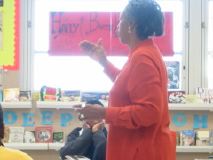
samples of classroom documents. In the video clips, Hutchinson reflects
on her expectations for the class, a student orally presents the “class
scribe” notes from the previous day, the students engage in small
group and large group discussion about a racially charged literary selection
that had been assigned the night before, and after the class, four students
reflect on their experiences in Hutchinson’s classroom, and how her
rigorous approach and emphasis on dialogue and diversity prepares them
for other academic work.
Context
and Reflections
- Thinking
with Text - Project
Snapshot - Teaching
Context: School and Students - Video:
What audiences of this work should know about Yvonne’s teaching, and
her journey to develop this approach. - Narrative:
Where I Began/ Where I Begin
Materials
and Strategies
- Strategies
for Promoting Literate Discourse - Question-Answer
Relationships • Student Response
Sample - Anticipation
Guide - Reading
Response Prompt - Class
Scribe Prompt • Class Scribe
Writing Sample - Informal
Reading Assessment

Video:
Entire class session (2 hours)
Entire reflective interview (1 hour)
How they got here:
The beginning of the school year
<<<<
Class
Anatomy Timeline
Class
Session: June 2002
Where
they went next:
The following school year
>>>>
1.
Setting Goals for the Class Session

YDH tells
what she expects to see as evidence of oral discourse as students
discuss a memoir by Willie
Ruff, “A Call to Assembly.” . (4:00)
2.
Describing the Previous Day’s Work

DJ, class
scribe for the previous day, delivers his lively and humorous narrative
of the class activities for that day. At the end of the report, his peers
evaluate both the report and his delivery. Daily class scribe reports
and related instructional materials or
handouts are kept in a Class Notebook in the classroom. (3:03)
(View the
Class Scribe Prompt,
or another student’s
Class
Scribe Writing Sample)
3.
Engaging in Small Group Discussion

Responding
to teacher’s directions to honor diversity in their choices of discussion
partners, students meet in duos or trios to share their responses to the
Anticipation Guide for “A Call
to Assembly.” (6:03)
4. Connecting
to Larger Societal Issues
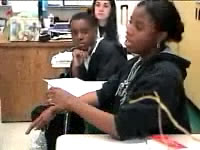
Andrea speaks
passionately about leaders from African American and Hispanic communities
and the difficulties of effecting change. She ends her talk with an indictment
of Black and Hispanic gangs and the diviseness among (and between) the
two racial groups. (3:41)
5. Making Explicit
Reference to the Text
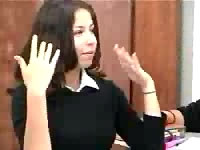
Gladis begins
the discussion of a pivotal moment in the text, questioning the use of
the perjorative “N” word. Tiffany shows discernment in her analysis
of the ten year old Ruff’s motive in quitting his job. Other students
voice their ideas, and the conversation culminates with Ashlan sharing
her knowledge of sign language. (3:41)
6.
Reflecting on the Impact of Diversity, Rigor, and Discourse

Dejean,
Andrea, Tiffany reveal how the requirement to honor diversity in their
classroom interactions not only broadened their perspective, but resulted
in new friendships. (1:44)